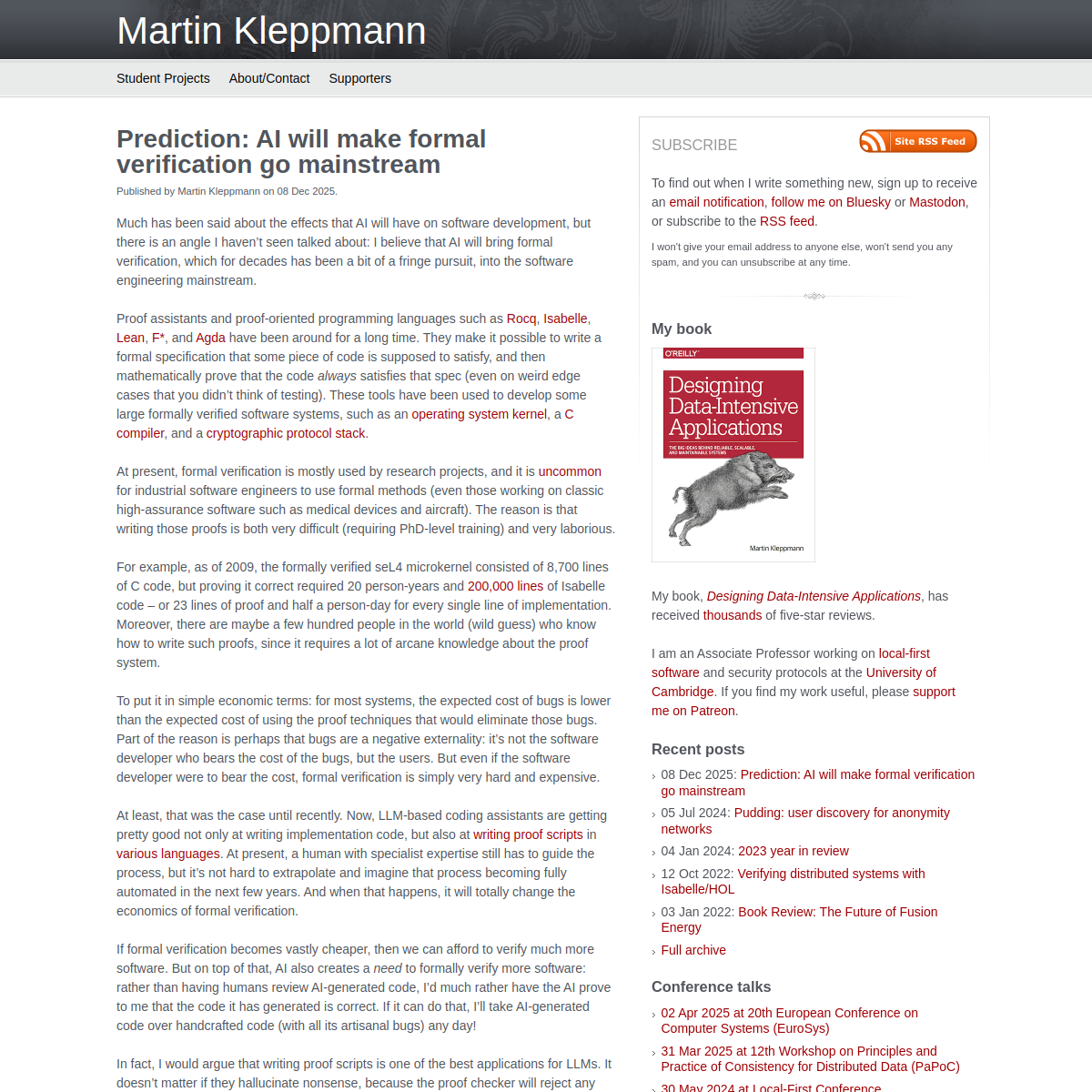
LLMs improve formal verification, making it easier and poised for widespread use in software correctness.
Formal verification is a rigorous method of mathematically proving the correctness of software, traditionally perceived as complex and niche. Recent advances indicate that large language models (LLMs) such as Claude 3.5 Sonnet can now assist substantially in authoring formal proofs and verification scripts for languages like Dafny, Nagini, and Verus. This assistance lowers the barrier to entry by automating portions of the verification process and making it more accessible to developers unfamiliar with formal methods. The impact of AI-enabled formal verification could be transformative, promoting more reliable and secure software development. By integrating LLM-powered proof generation into popular development workflows, teams can catch logical errors early and formally guarantee software behavior, addressing a longstanding challenge in software engineering. The JetBrains Research paper “Can LLMs Enable Verification in Mainstream Programming?” highlights promising results and a trend toward eventual mainstream adoption of these methods, supported by the synergy between human expertise and AI capabilities in proof generation.
Source: Martin Kleppmann’s Blog